

To redeem mutual funds is to sell your units back to the fund house at the day’s NAV. Online, it takes a few minutes. However, the time you place the request, any exit load and the tax on your gains all decide how much reaches your bank, and when.
This guide covers the process step by step, the timelines that apply, a worked example with real numbers, and the mistakes that cost investors money when they redeem.
What happens when you redeem mutual funds
A redemption request moves through five stages. Here is the path for a typical equity fund redemption placed online on a business day, which we call day T.
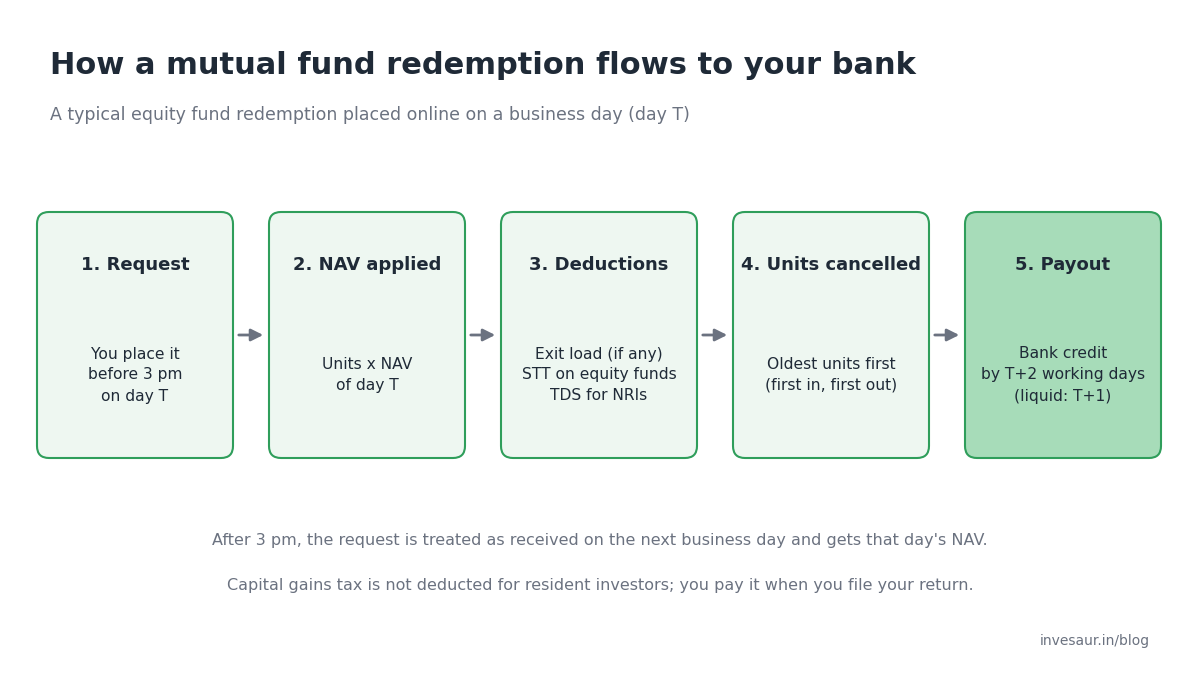
- Cut-off time: a redemption request received before 3 pm on a business day gets that day’s NAV. After 3 pm, it is treated as received on the next business day.
- Value: the number of units multiplied by the applicable NAV.
- Deductions: any exit load, a very small securities transaction tax on equity-oriented funds, and TDS for non-resident investors.
- Which units go first: the oldest units are redeemed first. This matters for both exit load and tax.
- Payout: the money goes only to your registered bank account.
Since February 2023, the industry has paid equity scheme redemptions within two working days of the request, known as T+2, as reported by Business Standard. Debt, liquid and overnight funds usually pay the next working day. In addition, some liquid funds offer instant redemption of up to ₹50,000 or 90% of your holding a day, whichever is lower.
How to redeem mutual funds online: step by step
- Log in where you hold the units. This can be your investment app, the fund house website, the registrar’s site (CAMS or KFintech), or MF Central, which covers funds serviced by both registrars.
- Pick the scheme and folio. Make sure it is the right plan, direct or regular, if you hold both.
- Choose what to redeem. You can redeem a set number of units, a rupee amount, or the whole holding.
- Check exit load and lock-in. Most platforms show whether any units are still inside an exit load window or a lock-in.
- Confirm. You will usually authorise the request with a one-time password.
- Track the credit. Note the reference number and check your bank account within the stated timeline.
If you hold units in a demat account, the route is different. In that case, you sell through your broker, and the proceeds come through the broker as well.
Worked example: what actually reaches your bank
Say you hold 800 units of an equity fund that you bought at a NAV of ₹55, ten months ago. Assume the scheme charges a 1% exit load on units redeemed within 12 months. You redeem 500 units before 3 pm on a day when the NAV is ₹62.40.
| Item | Calculation | Amount |
|---|---|---|
| Gross value | 500 × ₹62.40 | ₹31,200 |
| Exit load | 1% of ₹31,200 | − ₹312 |
| Securities transaction tax | 0.001% on equity fund redemptions | About ₹0.31 |
| Amount credited | Roughly ₹31,200 − ₹312 | About ₹30,888 |
| Cost of the units sold | 500 × ₹55 | ₹27,500 |
| Short-term capital gain | ₹30,888 − ₹27,500 | About ₹3,388 |
| Tax at 20% | Paid when you file your return | About ₹678, plus any surcharge and cess |
Notice two things. First, waiting two more months would have removed the exit load and moved the gain into the long-term bracket. Second, no tax is deducted at the time of redemption for resident investors, so you need to set it aside yourself.
Exit loads and lock-ins to check before you redeem
- Equity funds: many charge an exit load, often 1%, if you redeem within a set period such as a year. The exact terms vary by scheme, so check the scheme documents.
- Liquid funds: a small, graded exit load applies only if you redeem within the first six days.
- ELSS funds: each purchase has its own three-year lock-in. With a SIP, therefore, every instalment unlocks on its own date.
- Solution-oriented funds: retirement and children’s funds carry a lock-in of at least five years, or until retirement age or the child reaches majority, whichever comes first.
How redemption gains are taxed
| Type of fund | Holding period | Tax on the gain |
|---|---|---|
| Equity-oriented funds | Under 12 months | 20% short-term capital gains tax |
| Equity-oriented funds | 12 months or more | 12.5% long-term capital gains tax on gains above ₹1.25 lakh in a financial year |
| Debt funds bought on or after 1 April 2023 | Any period | Added to your income and taxed at your slab rate |
The Union Budget of February 2026 left these rates and the ₹1.25 lakh exemption unchanged. For the full picture, including dividends and older debt fund rules, see our guide to how mutual funds are taxed in India.
Redemption vs SWP vs switch vs STP
| Option | What it does | Best when |
|---|---|---|
| Redemption (full or partial) | A one-off sale of units | You need a lump sum, or you are leaving a fund |
| SWP | Redeems a fixed amount at regular intervals | You want a steady income from your holding |
| Switch | Redeems from one scheme and buys another at the same fund house | You are changing funds or moving from a regular to a direct plan |
| STP | Switches a fixed amount from one scheme to another at regular intervals | You want to move a lump sum into equity gradually |
Keep in mind that a switch is still a redemption for tax and exit load purposes. Our guide to the systematic withdrawal plan explains when an SWP beats a one-off sale.
Full vs partial redemption: pros and cons
Full redemption
- Pro: clean exit from a fund you no longer want, with one tax event to track.
- Pro: frees the whole amount for a goal or a better option.
- Con: can trigger a large gain in a single financial year.
- Con: easy to do on impulse during a market fall.
Partial redemption
- Pro: takes only what you need and leaves the rest invested.
- Pro: lets you spread gains across financial years.
- Con: oldest units go first, which may not be the ones you would choose.
- Con: several small sales are more work to track at tax time.
Common mistakes when you redeem mutual funds
- Selling in a panic. Redeeming during a sharp fall locks in the loss. Our guide on how to handle a stock market crash covers better responses.
- Missing the exit load window by days. Check the purchase date of your oldest units before you sell.
- Ignoring the yearly exemption. Spreading long-term equity redemptions across financial years can keep more of the gain within the ₹1.25 lakh limit.
- Outdated bank details. Payouts go only to the registered account, so update it before you need the money.
- Confusing stopping a SIP with redeeming. Stopping a SIP halts new instalments, while your existing units stay invested. See how to stop, pause or change a SIP.
How we measure success
A good redemption is one where the money arrives as expected and the rest of your plan stays intact. We suggest checking these points after every sale. None of them relies on a target figure.
- Amount check: the credit matches units × NAV, less any exit load.
- Timing check: the money arrives within the timeline for that type of fund.
- Tax check: the gains in your capital gains statement from CAMS or KFintech match what you report in your return.
- Goal check: the amount covers the goal it was meant for.
- Plan check: what remains still matches your target mix of funds.
Frequently asked questions
How long does it take to redeem mutual funds?
Equity funds usually pay within two working days of the request. Debt, liquid and overnight funds generally pay the next working day. Some liquid funds also offer instant redemption up to a daily limit.
Can I redeem my mutual fund units at any time?
Yes, for open-ended funds, on any business day. The exceptions are units still in a lock-in, such as ELSS units within three years or solution-oriented funds within their lock-in.
What is the cut-off time for redemption?
For redemptions, the cut-off is 3 pm on a business day. Requests received before then get that day’s NAV, and later requests get the next business day’s NAV.
Is TDS deducted when I redeem mutual funds?
Not for resident investors on capital gains. You pay the tax when you file your return. Non-resident investors, by contrast, have TDS deducted at the time of redemption.
Which units are redeemed first?
The oldest units are redeemed first, on a first in, first out basis. As a result, your exit load and holding period are worked out from your earliest purchases.
Can I cancel a redemption request?
Usually only before it is processed, and not every platform allows it. Once the NAV has been applied, the redemption generally cannot be reversed, so check the details before you confirm.
Will redeeming affect my running SIP?
A partial redemption does not stop your SIP. New instalments continue as scheduled unless you cancel the SIP separately.
Keep withdrawals in line with your goals. Invesaur brings your mutual funds, SIPs, goals and portfolio tracking into one place, so you can see what you hold before you decide to sell.
Mutual fund investments are subject to market risks. Read all scheme-related documents carefully.