

Flexi cap vs multi cap sounds like a naming quibble, yet the two categories follow very different rules. Both invest across large, mid and small companies. The real difference is who decides the mix: the regulator, or the fund manager.
This guide explains why both categories exist, how their rules work in practice, and how they compare on risk and role in a portfolio. It ends with a simple way to decide which one, if either, belongs in yours.
Why there are two categories
Until 2020, multi cap funds only had to invest across company sizes, with no fixed split. In practice, many held mostly large caps. So, in September 2020, SEBI required multi cap funds to hold at least 25% each in large, mid and small cap companies.
Many existing funds would have had to sell large caps and buy small caps quickly to comply. To avoid that, SEBI created a new flexi cap category in November 2020, with no size limits. As a result, many former multi cap funds moved into it. SEBI’s February 2026 circular on scheme categorisation kept both sets of rules in place.
How flexi cap vs multi cap rules actually work
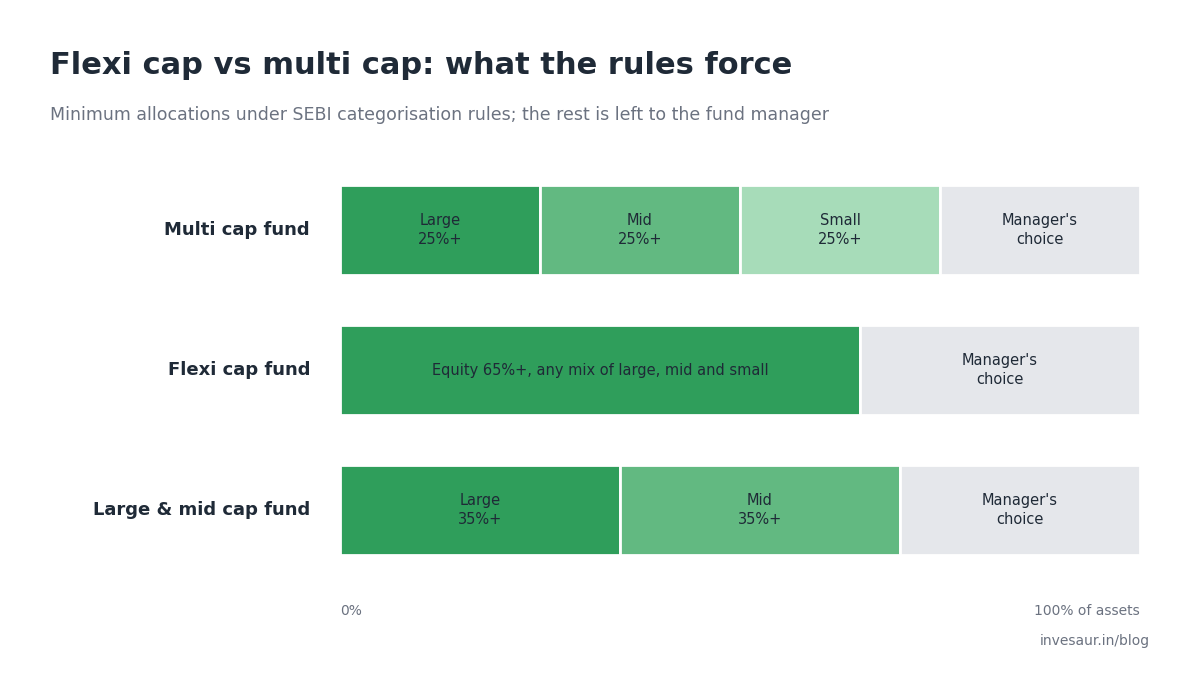
Multi cap funds must keep at least 75% of assets in equity, with at least 25% each in large, mid and small cap companies. The remaining 25% is the manager’s choice.
Flexi cap funds must keep at least 65% in equity. However, the split between large, mid and small caps is entirely up to the manager.
Here is what that means in practice. Suppose small caps look expensive after a long rally. A flexi cap manager can cut small caps sharply, or drop them altogether. A multi cap manager, by contrast, must still hold at least 25% in small caps and can only tilt within the free 25%. The reverse also holds: when small caps rally, the multi cap fund benefits automatically, while a flexi cap fund benefits only if its manager chose to own them.
For a refresher on how the size bands are defined, see our guide to large cap vs mid cap vs small cap funds.
Flexi cap vs multi cap: side-by-side comparison
| Feature | Flexi cap fund | Multi cap fund | Large and mid cap fund |
|---|---|---|---|
| Minimum in equity | 65% | 75% | 70% (35% + 35%) |
| Fixed size split | None | At least 25% each in large, mid and small | At least 35% each in large and mid |
| Minimum small cap holding | None | 25% | None |
| Who sets the mix | Fund manager | Rules set most of it | Rules set most of it |
| Behaviour in a small cap fall | Depends on the manager’s choices | Always feels it | Largely shielded |
| Main risk | The manager’s calls | Forced small cap exposure | Mid cap swings |
| Common benchmark | A broad market index such as the Nifty 500 | The Nifty 500 Multicap 50:25:25 index | A large and mid cap index |
Pros and cons of each
Flexi cap funds
- Pro: the manager can move away from expensive parts of the market.
- Pro: works well as a single, diversified core holding.
- Con: results depend heavily on the manager’s judgement.
- Con: the mix can change a lot over time, so you need to check what you actually own.
Multi cap funds
- Pro: guaranteed exposure to mid and small caps, which can add growth over long periods.
- Pro: more predictable mix, so it is easier to plan around.
- Con: must hold small caps even when they look overpriced.
- Con: usually more volatile than a flexi cap fund that leans towards large caps.
Flexi cap vs multi cap: which should you choose?
- Want one fund to cover equity? A flexi cap fund is the more natural single holding, since the manager adjusts the mix for you.
- Want a set share in smaller companies? A multi cap fund delivers that by rule, without relying on the manager’s view.
- Already own a small cap fund? Then a multi cap fund adds more of the same. In that case, a flexi cap or large cap fund may balance you better.
- Watch for overlap. Holding several diversified equity funds often means owning the same large caps many times over. Our guide on how to choose a mutual fund covers this.
- New to equity? Start with one diversified fund through a SIP, then add more only with a clear reason. See the types of mutual funds in India for the wider picture.
Whichever you pick, costs still matter. Compare the direct and regular plans of the same scheme before you invest.
How we measure success
Because these two categories hand different amounts of control to the manager, judge them on slightly different grounds. This framework uses no target figures, since a fair number depends on the market cycle.
- Right benchmark: compare a multi cap fund with a 50:25:25 multicap index, and a flexi cap fund with a broad market index.
- Rolling returns: look at how often each fund beat its benchmark across many start dates.
- Falls: compare how far the fund dropped in weak periods against its benchmark.
- Manager’s choices: for a flexi cap fund, track the size split in the monthly factsheet and ask whether the shifts helped.
- Your own result: measure your actual return with XIRR. Our guide to XIRR vs CAGR explains why.
Frequently asked questions
Is a flexi cap fund safer than a multi cap fund?
Not by rule. A flexi cap fund can be steadier if the manager leans towards large caps, but it can also take big bets. A multi cap fund always holds at least 25% in small caps, which tends to make it more volatile.
Can a flexi cap fund hold only large caps?
Yes. The only rule is at least 65% in equity. In theory, a flexi cap fund could hold almost all large caps, and some do lean heavily that way.
Why did many multi cap funds become flexi cap funds?
When SEBI introduced the 25% split in 2020, many multi cap funds held mostly large caps. Moving to the new flexi cap category let them keep their approach without a forced portfolio shift.
Can I hold both a flexi cap and a multi cap fund?
You can, but check the overlap first. Both hold large caps, so you may own many of the same companies twice. Make sure the second fund adds something the first one lacks.
Which has more small cap exposure?
A multi cap fund, by rule, holds at least 25% in small caps. A flexi cap fund may hold more or less, depending entirely on the manager.
Are these funds suitable for a SIP?
Yes. Both are diversified equity funds, so they suit a long-term SIP. A step-up SIP can help your instalment keep pace with your income.
Keep your equity mix simple. Invesaur helps you invest in curated mutual funds, plan goals and track your SIPs in one place, so you can see how each fund fits your plan.
Mutual fund investments are subject to market risks. Read all scheme-related documents carefully.