

Large cap vs mid cap vs small cap is the first real choice most equity investors face. The labels sound simple, yet each one refers to a precise band of companies ranked by size, and each fund category has rules on how much it must hold in its band.
This guide explains where the lines are drawn, how the rules work when a company moves between bands, and how the three compare on risk, liquidity and role in a portfolio. It closes with a simple way to decide which mix suits you.
How large cap, mid cap and small cap companies are defined
First, all listed companies are ranked by full market capitalisation, which is the share price multiplied by the total number of shares. Then the list is cut into three bands:
- Large cap: companies ranked 1 to 100.
- Mid cap: companies ranked 101 to 250.
- Small cap: companies ranked 251 and below.
AMFI publishes the updated list every six months, and fund houses use it to classify what they hold. You can see the latest version on the AMFI website.
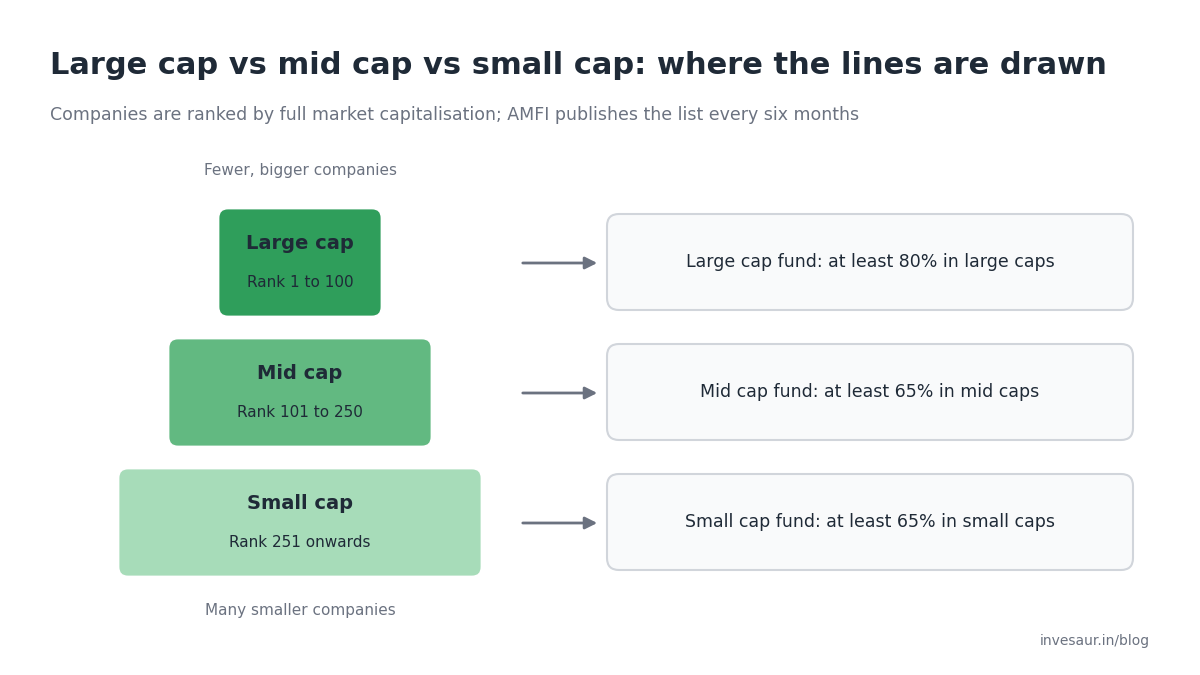
What each fund category must hold
SEBI sets a minimum share of assets that each category must keep in its own band. In February 2026, SEBI issued a fresh circular on the categorisation and rationalisation of schemes. It kept these minimums unchanged and gave existing schemes six months to align with the wider changes.
| Fund category | Minimum in its own band | What the rest can hold |
|---|---|---|
| Large cap fund | 80% in large cap companies | Other equity, money market instruments, gold and silver instruments, and InvITs, within SEBI limits |
| Mid cap fund | 65% in mid cap companies | Same as above |
| Small cap fund | 65% in small cap companies | Same as above |
This gap explains a common surprise. A mid cap fund can legally hold up to 35% in large or small companies, so two mid cap funds can feel quite different in a market fall. It is worth checking the factsheet, therefore, rather than relying on the name alone.
How it actually works: when a company changes bands
Ranks change as share prices move. Take a hypothetical company ranked 240 in one AMFI list, which makes it a mid cap. Over the next six months its share price doubles, and the next list ranks it 95. It is now a large cap.
For a mid cap fund that owns it, that holding now counts on the large cap side. If enough holdings graduate this way, the fund’s mid cap share can slip below 65%. In that case, the fund has to rebalance within the time SEBI allows.
Small cap funds face this most often. Their best picks tend to grow out of the band, so the manager must keep finding new small companies to stay within the rules. In other words, success itself forces turnover.
Large cap vs mid cap vs small cap: side-by-side comparison
| Feature | Large cap funds | Mid cap funds | Small cap funds |
|---|---|---|---|
| Type of company | Established market leaders | Growing businesses | Smaller, earlier-stage companies |
| Price swings | Lowest of the three | Higher | Highest |
| Ease of selling the underlying shares | Deep markets | Moderate | Thin; can be hard to exit in a fall |
| Analyst coverage | Heavy, so prices are efficient | Moderate | Light, so more room for stock-picking |
| Typical role in a portfolio | Core holding | Growth addition | Smaller, long-horizon addition |
| Index fund option | Nifty 50 or Nifty 100 trackers | Nifty Midcap 150 trackers | Nifty Smallcap 250 trackers |
| Holding period needed to ride out falls | Long | Longer | Longest |
Pros and cons of each category
Large cap funds
- Pro: the steadiest of the three, so they suit a core holding.
- Pro: easy to buy and sell the underlying shares, even in stressed markets.
- Con: prices are well researched, so active managers find it hard to beat the index after costs.
- Con: growth tends to be slower than in smaller companies over long rallies.
Because beating the index is hard here, a low-cost index fund is a strong alternative. Our guide to index funds vs actively managed funds covers that choice in detail.
Mid cap funds
- Pro: businesses with room to grow, which often become tomorrow’s large caps.
- Pro: more scope than large caps for a skilled manager to add value.
- Con: noticeably sharper falls than large caps in weak markets.
- Con: valuations can run ahead of earnings during long rallies.
Small cap funds
- Pro: the widest field of companies, and the most room for research to pay off.
- Pro: can add meaningful growth to a long-term portfolio.
- Con: the deepest falls, and recoveries that can take years.
- Con: the underlying shares can be hard to sell, so some fund houses have, at times, limited lump-sum inflows to protect existing investors.
How to choose between large cap vs mid cap vs small cap funds
- Start with the goal and the date you need the money. The shorter the time frame, the more weight belongs in large caps, or outside equity altogether.
- Be honest about how you react to falls. If a sharp drop would make you stop investing, a heavy small cap tilt will hurt you more than it helps. Our list of common mutual fund mistakes shows how often this happens.
- Build a core and add around it. Many investors keep large caps as the core and add mid and small caps in smaller amounts.
- Spread your entry with a SIP. Regular instalments smooth out the timing risk, which matters most in volatile categories. See how to start a SIP.
- Watch for overlap. If you already own a flexi cap or multi cap fund, you may hold these bands already. Our comparison of flexi cap vs multi cap funds explains how those categories mix them.
How we measure success
Once you hold these funds, judge each one against its own band rather than against each other. This framework keeps the comparison fair. It sets no target figures, because those depend on market conditions and your goal.
- Right benchmark: compare large cap funds with a large cap index, mid caps with a mid cap index and small caps with a small cap index.
- Rolling returns: check how often the fund has beaten its benchmark across many start dates, not just one.
- Falls: compare how far the fund fell in bad periods against its benchmark.
- True to label: check the factsheet to see that the fund stays in its band.
- Your own return: track your actual result with XIRR. Our guide to XIRR vs CAGR shows how.
- Mix drift: once a year, compare your actual split across the three bands with the split you planned.
Frequently asked questions
Which is better: large cap, mid cap or small cap?
None is better in every period. Large caps are steadier, while mid and small caps can grow faster but fall harder. The right mix depends on your time frame and how you handle volatility.
Is a small cap fund riskier than a mid cap fund?
Generally, yes. Small companies tend to swing more in price, and their shares are harder to sell in a falling market. That combination usually makes small cap funds the most volatile of the three.
Can I hold large cap, mid cap and small cap funds together?
Yes, and many investors do. A common approach is a large cap core with smaller amounts in mid and small caps. Just check for overlap if you also hold a flexi cap or multi cap fund.
How often does a company’s category change?
AMFI updates the ranking list every six months. A company can move up or down a band in each update, depending on how its market value has changed.
Do large cap funds always give lower returns?
No. In some periods large caps lead, and in others smaller companies do. Over any single stretch, any of the three can come out ahead.
Should I start a SIP in a small cap fund?
A SIP suits small caps well because it spreads your entry over time. Even so, only commit money you will not need for many years, and keep it a modest share of your total. Our guide on how much to invest in a SIP can help with the amount.
Plan the mix that fits your goals. Invesaur helps you invest in curated mutual funds, plan goals and track your SIPs in one place, so it is easier to see how your large, mid and small cap holdings add up.
Mutual fund investments are subject to market risks. Read all scheme-related documents carefully.